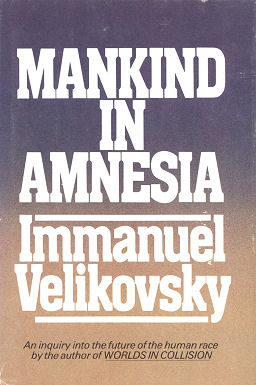
Mankind in Amnesia is a book (1982)[1]Immanuel Velikovsky, Mankind in Amnesia, 1982, Doubleday & Company, ISBN 0-385-03393-1 Libary of Congress Card No: 79-7222 by Immanuel Velikovsky described by Lynn E. Rose as follows:
“Immanuel Velikovsky described his work on collective amnesia as follows: “Mankind in Amnesia has to do not only with the past, like my other books — primarily it has to do with the future, a future not removed by thousands or tens of thousands of years, but the imminent future, on whose threshold we now stand”.
“The subject that Immanuel Velikovsky has chosen is the psychological condition and case history of the human race. Virtually every aspect of human behavior, every pattern in human history, and every article of human belief, if examined and illuminated in the light of the thesis of this book, reveals how human thought and action have been shaped and molded by repressed collective memories of cosmic catastrophes that befell our ancestors as recently as one hundred generations ago…
“Velikovsky wrote Mankind in Amnesia over the course of many years. Most of it was written in the 1950s and early 1960s, but he added sections as late as 1979, the last year of his life.
“The theme of collective amnesia was so important to Velikovsky that during those many years he never failed to include it in his lectures in colleges and universities, in several cases devoting the entire lecture to the subject.”[2]Lynn E. Rose, “Forward”, in Immanuel Velikovsky, Ramses II and his Time, Another Volume in the Ages in Chaos Series, 1978, Doubleday & Company, Garden City, New York, ISBN: 0-385-033494-X
The book was published posthumously in 1982, three years after Velikovsky’s death, with the help of his widow, Elisheva Velikovsky, their assistant Jan N. Sammer, and Velikovsky’s executor, Lynn E. Rose.
Review
Writing in the The Jerusalem Post Magazine, Ralph Amelan writes:
“Velikovsky was a psychoanalyst by profession, and his contributions to the field were highly regarded by Freud and Bleuler. Until 1939 he practised in Haifa. In Mankind in Amnesia, published posthumously, he examines the implications for psychology of the repression of these catastrophes in the memory of mankind. He suggests that the existence of many deep-seated fears in the human mind, recognized by the founders of psychology as not rooted in individual experience, is due to the repression of this memory, transmitted from generation to generation as part of man’s collective unconscious. It is repressed because of an unwitting decision to block out the terror of catastrophe.”
“To support his arguments, Velikovsky delves into the history of science to show how the prevailing belief in past catastrophes, accepted by Plato, was overturned by the rigidly mechanistic Aristotelian system, which denied their possibility. Similarly, the geological catastrophist school of Buckland and Cuvier, that dominated the early 19th century, was swept aside by Darwin and Lyell, the founders of evolutionary science. Yet Darwin, on his famous Galapagos expedition, saw for himself the evidence for massive, sudden faunal extinction, and noted in his journal, “The mind at first is hurried into the belief of some great catastrophe, but thus to destroy animals, both large and small … we must shake the entire framework of the globe,” But in Origin of Species, two decades later, he wrote “We may feel certain … that no cataclysm has desolated the whole world. Hence we may look forward with some confidence to a secure future of great length.” Evidence to the contrary was passed over.”[3]Ralph Amelan, The Jerusalem Post Magazine, 30 April 1982. Reprinted in SIS Workshop Vol 4 No 4 (Mar 1982)
Book contents
- FOREWORD by Lynn E. Rose
- PROLOGUE: The Good Earth
- Chapter I: OF RACIAL MEMORY
- An Amnesia Victim
- Mind’s Frontiers
- Collective Unconscious Mind
- Jung’s Archetypes
- Freud’s Descent into Hades
- Of Racial Memory
- Mankind’s Delusion
- The Archaic Trauma
- Chapter II: TO KNOW AND NOT TO KNOW
- A Reconstruction of Events
- To Know and Not to Know
- Isaiah
- Early Attempts at Rationalizing
- Plato
- Aristotle and Amnesia (by Lynn E. Rose)
- The Roman Philosophers
- The Rise of Aristotelianism
- Copernicus
- Galileo and Giordano
- Nicolas-Antoine Boulanger
- Laplace’s Dichotomy
- Darwin
- Natural Evolution and Revolution
- Karl Marx’s Misapprehension
- Two Forms of Fear
- A Choice
- “A Degradation of Science and of Religion”
- A Firmament
- Chapter III: IN FEAR AND TREMBLING
- Planet Cods
- he Feast of Light
- First Century: Visions of Apocalypse
- The Seventh Century and the Dark Ages
- Mid-Fourteenth Century: A Periodicity of Frenzy
- “There’s No Hiding Place Down There”
- Chapter IV: POETS AND VISIONARIES
- Shakespeare, Three Generations After Copernicus
- The Shadow of Death
- Nevermore
- Mind at the End of Its Tether
- Chapter V: THE AGE OF TERROR
- “Why War?”
- The Recurrent Scourge
- The Chosen People of Hiroshima
- Of the Roots of Anti-Semitism
- The Slave Traders and the Slaves
- Explosion of Population
- Armageddon on the Drawing Boards
- Chapter VI: DREAMS AND HALLUCINATIONS
- To Open a Door
- Bedlam’s Basement
- Planets in Dreams and Anxiety
- Tornado
- Chapter VII: A CHRONICLE OF OUR TIME
- Mnemes Awakened
- Late 1960s Student Unrest
- Dismayed and Confounded
- Man Landing on the Moon
- Pages from a Newspaper
- The Fire Gate
- The Three Giants
- Guyana Mass Suicide
- Living by the Bomb
- EPILOGUE
- ABOUT THE AUTHOR
- INDEX
Publishing details
- Author: Immanuel Velikovsky
- Title: Mankind in Amnesia
- Subtitle: An inquiry into the future of the human race
- Publ. date: Dec 1981. ©1982
- Publisher Doubleday & Company
- ISBN ISBN 0-385-03393-1
- LIC No: 79-7222
- Dedicated: To my grandchildren:
Meir, Naomi, Rivka, Rafael, Carmel
References
| 1. | ↑ | Immanuel Velikovsky, Mankind in Amnesia, 1982, Doubleday & Company, ISBN 0-385-03393-1 Libary of Congress Card No: 79-7222 |
| 2. | ↑ | Lynn E. Rose, “Forward”, in Immanuel Velikovsky, Ramses II and his Time, Another Volume in the Ages in Chaos Series, 1978, Doubleday & Company, Garden City, New York, ISBN: 0-385-033494-X |
| 3. | ↑ | Ralph Amelan, The Jerusalem Post Magazine, 30 April 1982. Reprinted in SIS Workshop Vol 4 No 4 (Mar 1982) |